


AI Digital Twin (AIDT)
AI Digital Twin (AIDT)
Bringing Human-Centric Manufacturing into the Virtual World
Manufacturing companies are under growing pressure to design, test, and adapt production systems faster, while ensuring that people, robots, and machines can work together safely and efficiently. Within the CONVERGING project, Visual Components developed the AI Digital Twin (AIDT) module to support this transition through intelligent virtual representations of manufacturing environments.
Built on the Visual Components simulation platform, AIDT combines digital twin technology, artificial intelligence, robotics, and data-driven analysis. It enables manufacturers to explore production concepts, compare alternatives, and validate decisions in a virtual environment before making changes on the real shop floor. This helps reduce disruption, lower deployment risks, and support better-informed engineering decisions.
As illustrated in the AIDT overview Figure 1, the module connects simulation, AI, production data, and human-centric analysis into a unified digital twin environment.
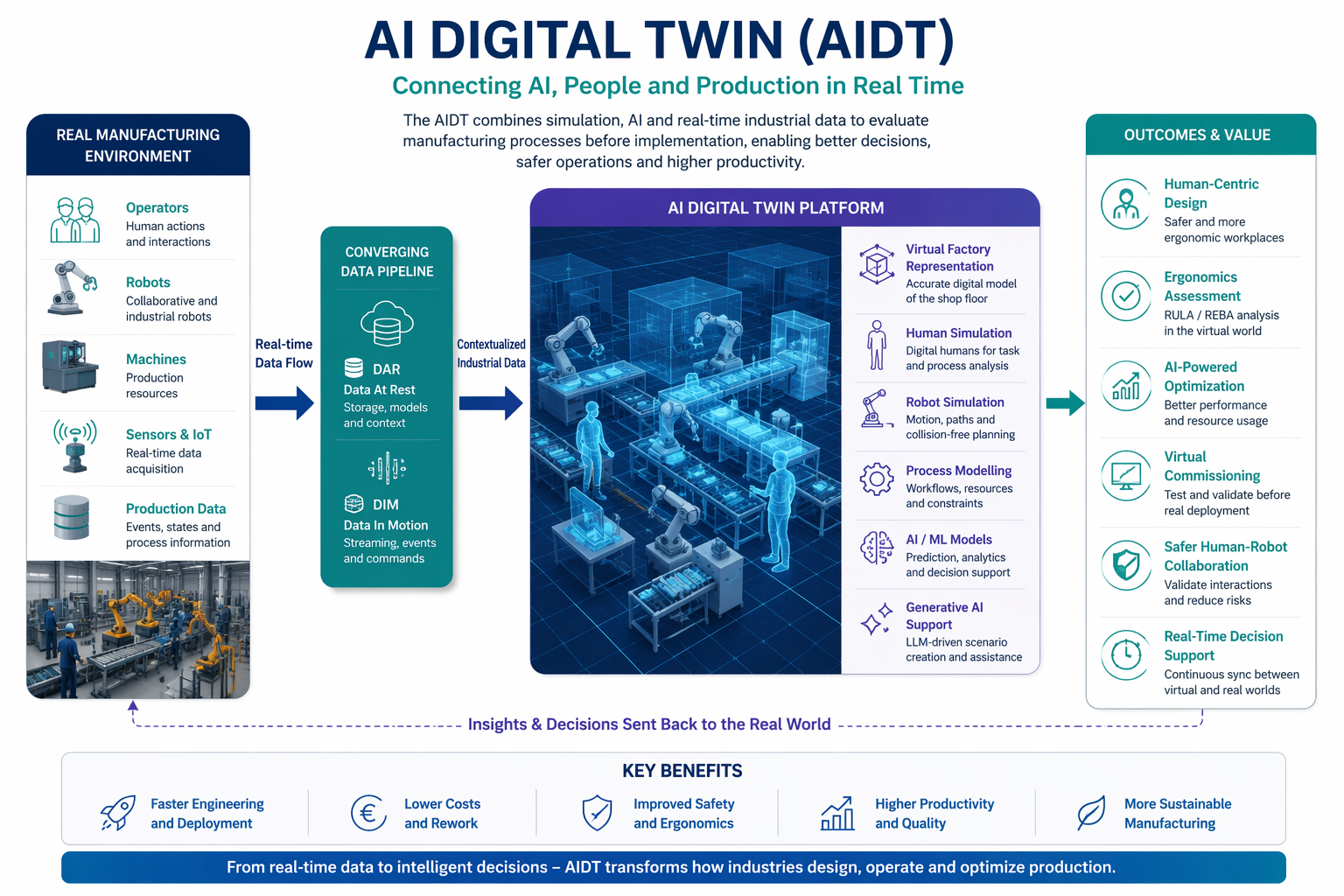
Figure 1 AI Digital Twin (AIDT) overview: connecting simulation, AI, industrial data, and human-centric analysis to support virtual validation before shop-floor implementation.
Supporting Human-Centric Manufacturing
A key focus of AIDT is human-centric manufacturing. Modern production systems require closer cooperation between operators, robots, and digital tools. AIDT provides a safe virtual space where engineers can study production flows, assess workplace ergonomics, evaluate collaborative operations, and identify opportunities for improvement without interrupting ongoing production.
Key Innovations Developed in CONVERGING
Several innovations were developed and tested to strengthen the role of digital twins in industrial environments:
· Human-centric digital twins that support ergonomic assessment using RULA and REBA methods, helping engineers evaluate working postures and potential strain before production changes are introduced.
· Digital human modelling for analyzing worker interactions, accessibility, and collaborative operations in virtual production environments.
· AI-assisted robot path planning and collision avoidance to support safer and more efficient automation.
· Large-scale factory virtualization using point-cloud-based environment modelling to represent real production spaces more accurately.
· Experimental integration of Large Language Models (LLMs) to simplify simulation creation and interaction with digital twin environments.
· Communication interfaces that connect digital twins with AI, machine learning, and planning systems.
· Support for digital continuity across the manufacturing lifecycle, from concept and engineering to operation and continuous improvement.
Demonstrated Across Industrial Pilots
The AIDT was demonstrated across multiple industrial pilot scenarios, including automotive, additive manufacturing, aeronautics, and white-goods production. In these environments, the technology supported virtual commissioning, ergonomic validation, robot path optimization, and synchronization between physical and digital manufacturing assets.
Together, these pilots showed how an intelligent digital twin can act as a practical testing ground where production ideas, robot behaviors, and human-centered design choices can be assessed before deployment.
Industrial Impact
From an industrial perspective, AIDT shows how intelligent digital twins can help manufacturers:
· Reduce engineering and commissioning effort.
· Accelerate deployment of new production solutions.
· Improve workplace ergonomics and worker safety.
· Support safer and more efficient human-robot collaboration.
· Enable data-driven decision making throughout the production lifecycle.
· Validate production changes virtually before implementation on the shop floor.
Looking Ahead
Looking ahead, the work carried out in CONVERGING shows how AI-enabled digital twins can become an important foundation for more adaptive, collaborative, and resilient production systems. By connecting simulation, AI, robotics, and human-centric analysis, AIDT supports a future where manufacturing decisions can be tested and improved virtually before they shape the real factory floor.
Short takeaway: AIDT shows how intelligent digital twins can help manufacturers design safer, smarter, and more adaptable production systems before changes reach the shop floor.
Milan Gautam & Fernando Ubis, Visual Components