


AI-enabled shopfloor orchestration and event-driven data streaming for human-centric smart manufacturing
Smart manufacturing is no longer about isolated robots, sensors, or automation cells. The key challenge is real-time coordination across people, robots, tasks, safety events, and shopfloor data within connected cyber-physical production systems.
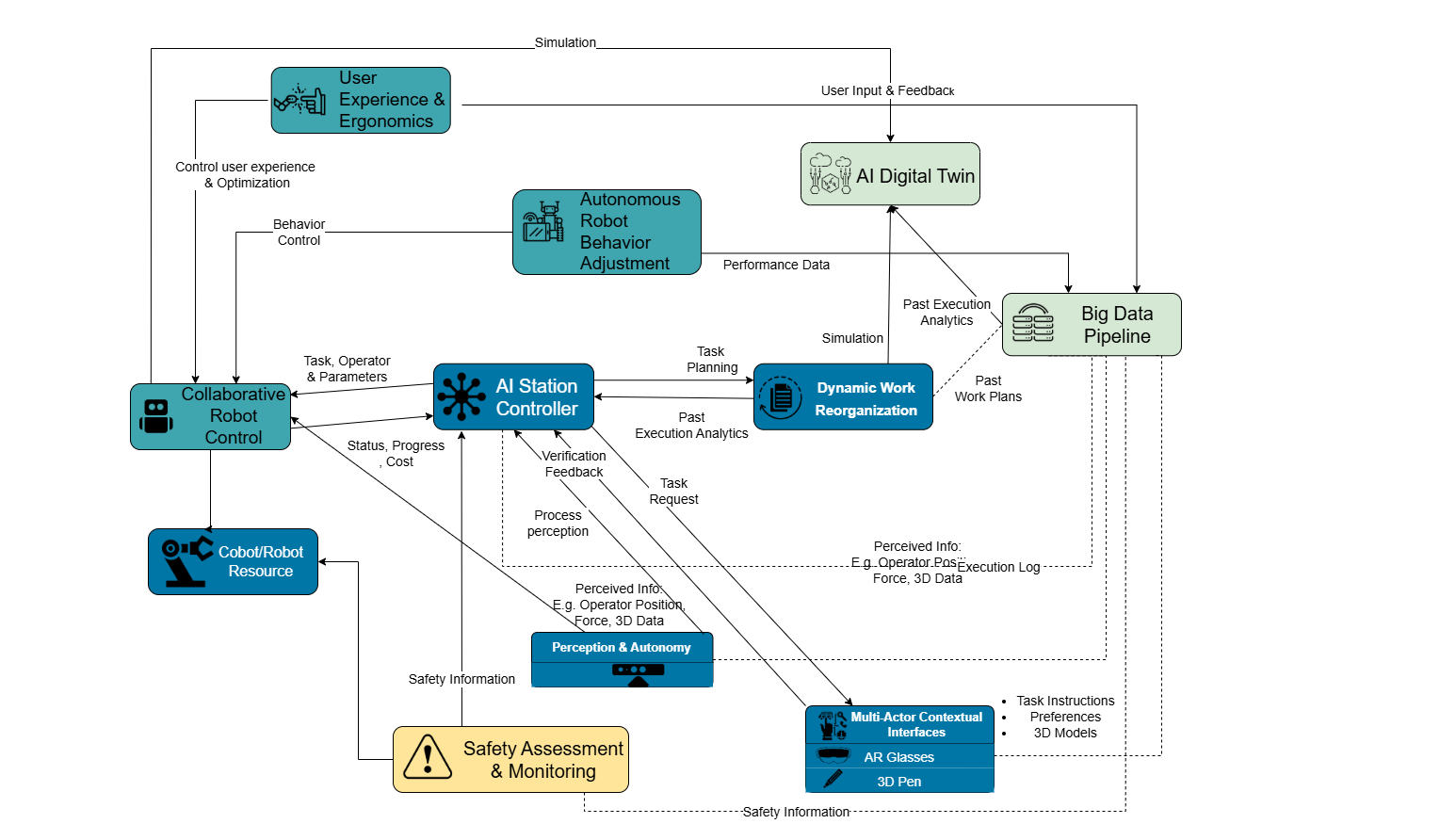
CONVERGING addresses this through two core capabilities: AI Shopfloor Execution Orchestration and the Real-Time Data Pipeline. Together, they form the operational and data backbone for connected, adaptive, human-centric, and reconfigurable manufacturing aligned with Industry 5.0 principles.
CONVERGING contributes to the broader European Industry 5.0 architecture ecosystem, complementing initiatives such as ODIN that explore interoperable, collaborative, and human-centric industrial systems through open, modular, and data-driven software architectures.
Human Centric Design strengthens this approach by ensuring that automation, industrial AI, data flows, and AI-supported decisions remain aligned with operator needs, safety, usability, ergonomics, and collaboration quality. This perspective is further developed in the CONVERGING-related work on Human Centric Design, which positions people as active participants in smart manufacturing systems. The approach supports safer and more effective human-robot collaboration (HRC), context-aware assistance, and operator-centered industrial intelligence.
The orchestrator coordinates schedules, tasks, actions, operators, robots, and services across distributed manufacturing environments. It tracks what is running, which task is active, which action is executed, when it starts and ends, and how long it takes, creating the basis for traceability, performance analysis, and optimization.
The real-time data pipeline captures execution evidence and results through an event-driven architecture based on Apache Kafka. It collects, processes, transforms, and distributes streaming industrial data from AISC connectors, ROS2 topics, MQTT streams, database events and industrial IoT (IIoT) devices. Through publish-subscribe communication and scalable event streaming, the platform enables manufacturing observability and real-time industrial analytics.
Added value emerges when orchestration and streaming operate together: the orchestration layer defines execution logic, while the real-time data pipeline makes execution observable and measurable. This allows manufacturers to answer questions such as which schedule ran, which task was active, which robot, operator, or industrial system generated data, how long execution took, and whether execution completed successfully. The result is a reusable digital thread connecting execution, monitoring, analytics, and optimization.
This transforms shopfloor activity from isolated actions into a measurable, interoperable and data-driven industrial process. The architecture incorporates loosely coupled services, Kafka Connect, SMTs, Java connectors, Docker, ROS2, MQTT, CDC, JSON messaging, and scalable Kafka deployment patterns such as KRaft, supporting modular manufacturing, interoperability, and scalable edge-to-cloud integration.
For manufacturers, the benefits are practical and immediate: real-time visibility, stronger traceability, improved resilience, easier plug-and-produce integration of new devices and services, and better performance analysis through execution statistics and operational KPIs. Supporting components further extend this value through historical storage, semantic asset standardization, simulation, hybrid digital twins, and AI-driven optimization.
Validated across industrial Additive Manufacturing, Automotive, Whitegoods, and Aeronautics pilot environments, the AI Shopfloor Execution Orchestration and the Real-Time Data Pipeline demonstrated that the architecture is reusable across industrial domains and adaptable to different production scenarios. The platform supports real-time coordination, continuous monitoring, faster deviation detection, distributed intelligence, improved human-robot coordination, and a clearer foundation for adaptive, resilient, and reconfigurable smart manufacturing systems.
By combining AI-enabled orchestration with event-driven data streaming, CONVERGING demonstrates how Industry 5.0 manufacturing can evolve beyond isolated automation toward connected, observable, human-centric, and adaptive industrial intelligence. Through interoperable cyber-physical systems, collaborative robotics, real-time observability, and scalable edge-to-cloud architectures, the project establishes a reusable foundation for resilient, data-driven, and reconfigurable smart manufacturing ecosystems.
Senior Software Engineer-Technical Lead, Netcompany